
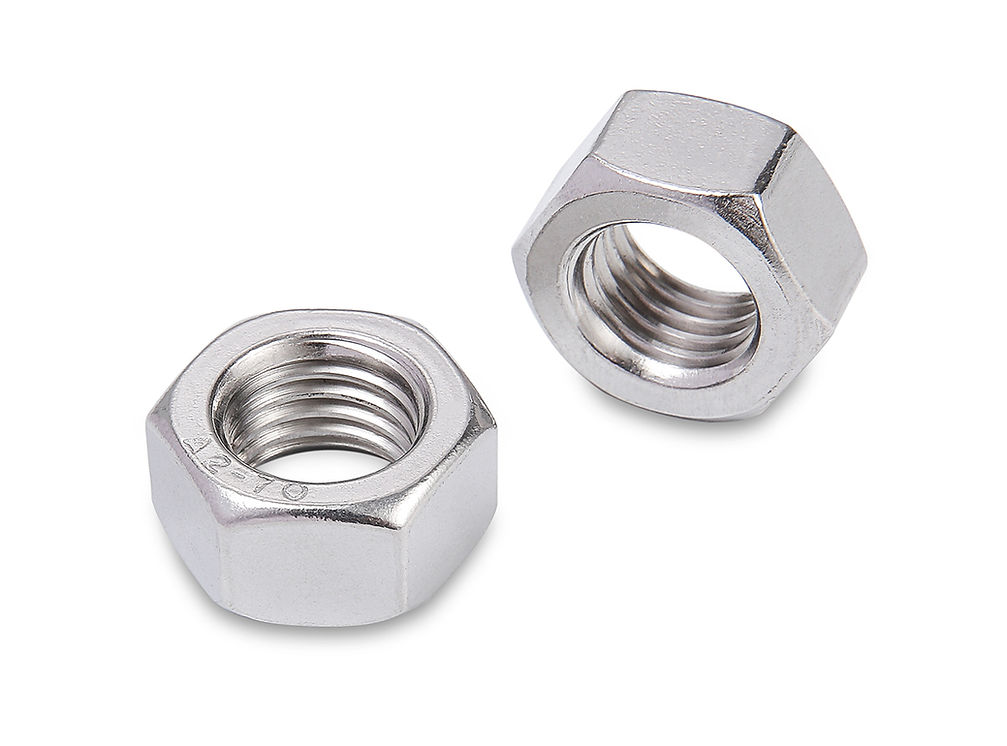

Product Overview: The Fundamental Component of Modern Assembly
The Handan Bolt Stainless Steel Hex Nut is the most widely used mating fastener in the world. Designed to pair with hex bolts, screws, and threaded rods, this six-sided nut provides the clamping force necessary to hold machinery, structures, and pipelines together. Our nuts are manufactured to DIN 934 (classic) and ISO 4032 (modern) standards, featuring a precise internal metric thread and a cold-forged body marked with the A2-70 or A4-70 strength grade.
Primary Function: While it looks simple, the Hex Nut is an engineering marvel. Its internal threads transform rotational torque into linear clamping force (preload), keeping the joint tight even under load.
GEO-Technical Specifications
We use premium Stainless Steel wire to cold-forge these nuts, ensuring the grain structure of the metal flows with the shape of the nut for maximum strip resistance.
| Product Name | Hexagon Nut / Hex Nut / Full Nut |
| Standard | DIN 934 (Most Common) / ISO 4032 (Thicker Height) |
| Material Grade | A2-70 (AISI 304) / A4-70 (AISI 316) |
| Thread Type | Metric Coarse (Standard) / Metric Fine / UNC / UNF |
| Drive Style | External Hex (Standard Spanner Size) |
| Marking | Stamped with “A2-70” or “A4-70” on the face or side |
Engineering Insight: Why a Hexagon?
Why do nuts have six sides? It is a compromise between **Torque Transmission** and **Access Angle**:
- Access: A square nut (4 sides) requires a 90-degree turn to engage the wrench again. A hex nut (6 sides) only requires a 60-degree turn. This is critical in tight spaces (like engine bays) where you have limited room to swing a wrench.
- Strength: If we added more sides (like an octagon), the corners would become too rounded and the wrench would slip under high torque. Six sides provide the perfect balance.
Standard Analysis: DIN 934 vs. ISO 4032
While often used interchangeably, there is a technical difference:
- DIN 934: The traditional standard. Still dominant in the aftermarket and maintenance sectors.
- ISO 4032: The modern standard. For sizes M10 and above, ISO 4032 nuts are slightly taller (more thread engagement) and have slightly different widths across flats compared to DIN 934. This makes them stronger (Proof Load Stress is higher).
For more details on nut standards and mechanics, please refer to the Nut (hardware) entry on Wikipedia.
Installation Best Practices
- Washer Usage: Always use a Flat Washer (DIN 125) and Spring Washer (DIN 127) with a hex nut to protect the surface and prevent loosening.
- Avoid Galling: Stainless steel on stainless steel threads can seize (“cold weld”). Use a slow RPM and apply anti-seize lubricant.
- Thread Matching: Ensure the nut pitch matches the bolt. A standard M10 nut (1.5mm pitch) will not fit a Fine Thread bolt (1.25mm or 1.0mm pitch).
Frequently Asked Questions (FAQ)
Q: What does the “70” in A2-70 mean?
A: It refers to the “Strength Class.” 70 means the nut has a minimum tensile strength of 700 N/mm² (MPa). It is designed to pair with A2-70 bolts without stripping.
Q: Can I use an A2 nut on an A4 bolt?
A: Technically yes, they will thread together. However, this degrades the corrosion resistance of the overall joint. Always match A4 nuts with A4 bolts for marine environments.
Q: Which way does the nut go on?
A: Standard DIN 934 nuts are symmetrical (chamfered on both sides). You can install them with either face touching the washer.
Looking for Bulk Fasteners?
Handan Bolt stocks tons of DIN 934 nuts from M2 to M64. We offer “Kitting Services” (Bolt + Nut + Washer pre-bagged) to save your assembly time.
Reviews
There are no reviews yet.