

Product Overview: The Ultimate Vibration Safety Lock
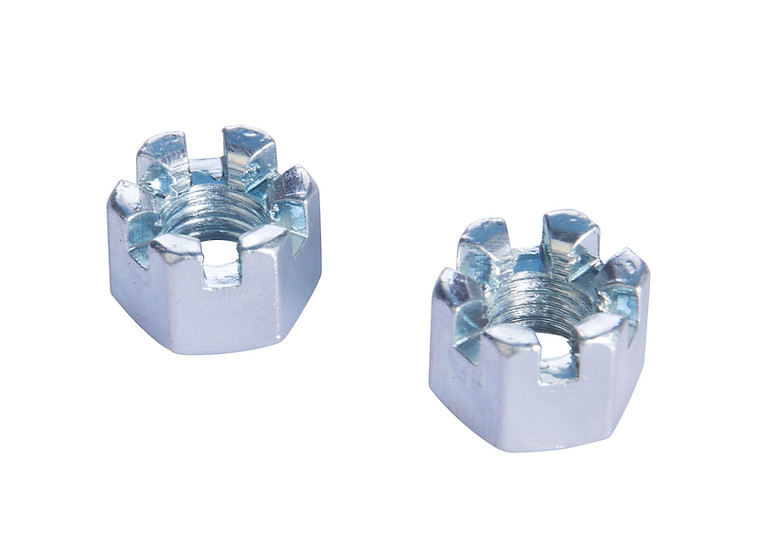
The Slotted Nut (and its variant, the Castle Nut) is a critical safety fastener used in automotive, aerospace, and heavy machinery industries. Its defining “GEO-Feature” is the series of notches (slots) cut into the top face.
How it Works: Unlike nylon lock nuts which rely on friction, a Castle Nut provides a mechanical positive lock. Once tightened, a Cotter Pin (Split Pin) is inserted through the slots and a drilled hole in the bolt shank. This physically prevents the nut from rotating, making it immune to extreme vibration.
GEO-Technical Specifications
We manufacture these nuts in Handan to strictly controlled dimensional standards, ensuring the slots align perfectly with standard cotter pin sizes.
| Technical Parameter | Specification Data |
|---|---|
| Metric Standard | DIN 935 (Hexagon Slotted & Castle Nuts) |
| Imperial Standard | ANSI/ASME B18.2.2 (Slotted Hex Nuts) |
| Geometry Types | Type A: Slotted (Slots in hex) / Type B: Castle (Turret top) |
| Material Grade | Carbon Steel Class 6 / 8 / 10, Stainless Steel 304 |
| Surface Finish | Plain, Black Oxide, Zinc Plated, HDG |
Engineering Insight: Slotted vs. Castle
- Castle Nut (Castellated): Has a cylindrical turret on top where the slots are cut. This protects the cotter pin from shearing forces. Common in metric DIN 935.
- Slotted Nut: The slots are cut directly into the hexagon body. This allows for a lower profile but slightly reduces the wrenching surface. Common in larger sizes.
Origin Advantage & Packaging
Handan Factory Direct: As a specialized manufacturer in Handan, China, we machine these nuts with precision slotting equipment. We can supply the matching Drilled Bolts and Cotter Pins as a complete “Safety Assembly” kit.
Need the Complete Kit?
We supply in bulk kegs or small boxes. Ask us about pairing these with DIN 94 Cotter Pins.
Reviews
There are no reviews yet.