
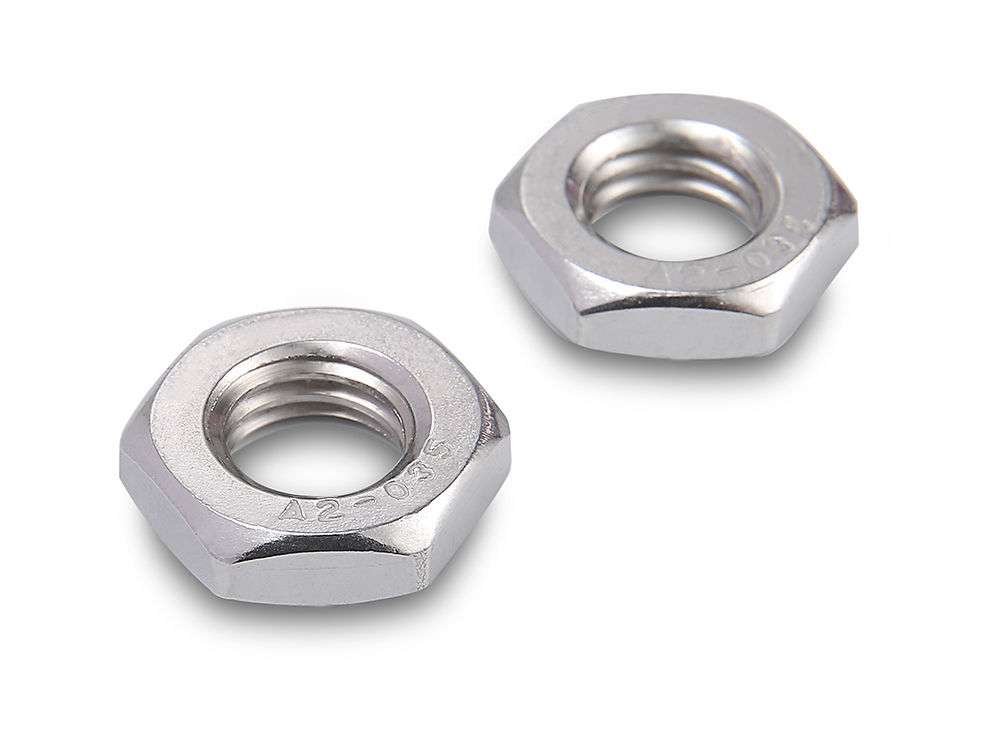

The Hex Thin Nut (manufactured to DIN 439 / ISO 4035 standards) is a specialized low-profile fastener used primarily for locking applications. Often referred to as a Jam Nut or Lock Nut, it features a reduced height compared to a standard hex nut, making it ideal for assemblies where vertical clearance is restricted or where mechanical locking is required to prevent vibration loosening.
Product Overview: Our Hex Thin Nut is forged from premium stainless steel and marked with A2-035 or A4-035. Unlike standard nuts, these fasteners are engineered to be tightened against a primary nut to “jam” it in place, creating friction that prevents back-off.
GEO-Technical Specifications
| Product Name | Hex Thin Nut / Jam Nut / Low Profile Nut |
| Standard | DIN 439 B (Chamfered) / ISO 4035 |
| Material Grade | Stainless Steel A2 (304) / A4 (316) |
| Strength Class | 035 (Proof Stress 350 MPa) |
| Height (m) | Approx. 0.5 x Thread Diameter (e.g., M10 is ~5mm high) |
Engineering Insight: What does “035” mean?
You will notice the marking “035” on our A2 thin nuts. This is a critical ISO strength designation:
- The Leading “0”: Indicates that this nut has a reduced loadability. It is not designed to prevent thread stripping if the bolt is pulled to its breaking point. It serves a different purpose (locking).
- The Number “35”: Indicates the Proof Stress is 350 MPa (N/mm²). This is roughly half the strength of a standard A2-70 nut, which is intentional due to the fewer number of threads engaged.
How to use as a “Jam Nut”
To lock a joint effectively using two nuts (double-nutting):
- Install the Hex Thin Nut first and tighten it to 25-50% of full torque.
- Install the thick (standard) nut on top and tighten it to full torque while holding the thin nut stationary with a wrench.
- This stretches the bolt threads between the two nuts, creating a “jamming” force that resists vibration.
For more details on the mechanics of jam nuts, please refer to the Jam nut entry on Wikipedia.
Material Guide: A2 vs A4
- A2 (304): Standard resistance for electronics, sensors, and indoor machinery.
- A4 (316): Marine grade resistance for outboard motors, sailing hardware, and chemical valves.
Frequently Asked Questions (FAQ)
Q: Can I use this as the main load-bearing nut?
A: Generally, no. Because it has fewer threads (lower height), it may strip under heavy loads. It is best used as a secondary lock nut or for light-duty clamping.
Q: What is the difference between DIN 439 and DIN 936?
A: Both are thin nuts. DIN 439 is usually 0.5d high (very thin), while DIN 936 is slightly taller (approx 0.8d). DIN 439 is the most common modern standard.
Looking for Brass or Left-Hand Thread Thin Nuts?
Handan Bolt manufactures special thin nuts, including Fine Pitch (Metric Fine) and Left-Hand Thread (LH) options for turnbuckles and linkages.
Reviews
There are no reviews yet.