
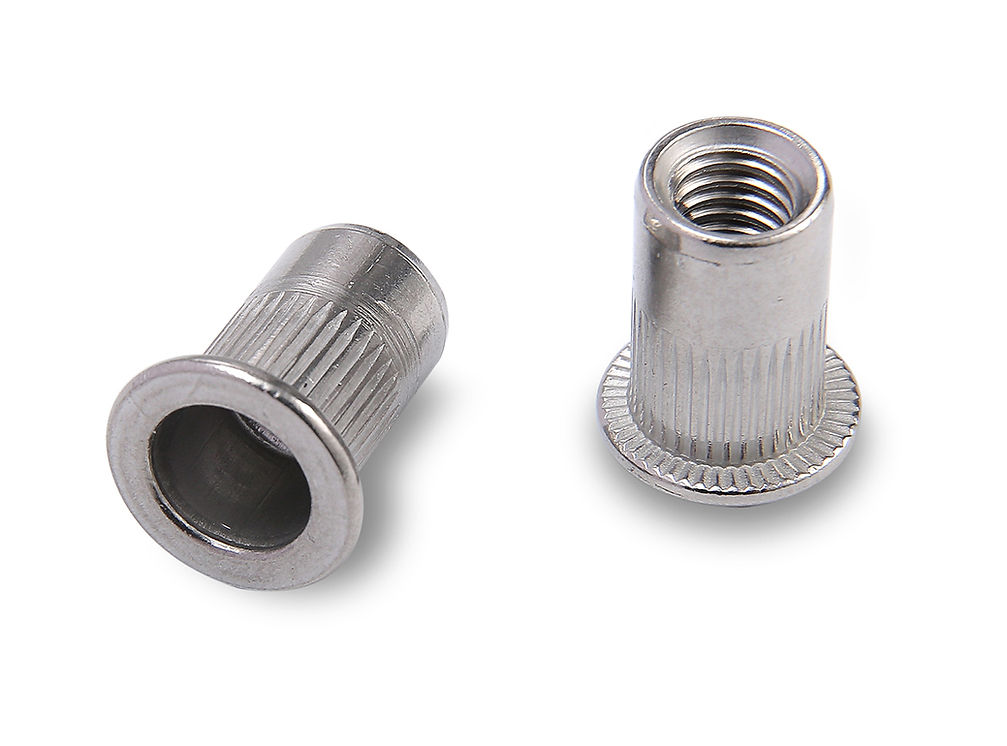

The Stainless Steel Rivet Nut (also known as a Blind Rivet Nut, Rivnut®, or Threaded Insert) is a versatile mechanical fastener that provides a strong, permanent thread in thin sheet metal or hollow profiles. Unlike standard nuts that require access to the back of the material, our Stainless Steel Rivet Nut is installed from one side (“blindly”), making it the indispensable solution for automotive chassis, aviation fuselages, and closed box sections where the rear is inaccessible.
Product Overview: Manufactured from premium Stainless Steel A2 (304) or A4 (316), this specific model features a Flat Head for maximum load bearing and a Knurled Body. The knurling bites into the pre-drilled hole, offering superior resistance to spinning (torque-to-turn) when a bolt is later installed.
Stainless Steel Rivet Nut Specifications
| Product Name | Rivet Nut / Blind Nut / Threaded Insert |
| Body Style | Round Knurled Body (Anti-Spin) |
| Head Style | Flat Head (Standard Flange) |
| Material Grade | Stainless Steel A2 (304) / A4 (316) |
| Thread Sizes | M3, M4, M5, M6, M8, M10, M12 |
Engineering Insight: Why use a Rivet Nut?
Engineers prefer the Stainless Steel Rivet Nut over weld nuts or tapping screws for several reasons:
- No Heat Distortion: Welding a nut to thin sheet metal (e.g., 1mm thick) causes warping and destroys the galvanization. Rivet nuts are a cold-installation process, preserving the panel’s integrity and finish.
- Load Capacity: In thin materials, tapping a thread directly is weak because there are only 1-2 threads of engagement. A Stainless Steel Rivet Nut provides at least 6-10 full threads, drastically increasing the pull-out strength.
- Anti-Spin Knurling: The vertical ridges (knurling) on the body are critical. When the rivet nut is compressed (bulged), these ridges dig into the wall of the hole, mechanically locking the nut to prevent it from rotating when you tighten the mating bolt.
For more history on blind fasteners, please refer to the Rivet nut entry on Wikipedia.
Installation Process
Installing a Stainless Steel Rivet Nut requires a specialized tool (Hand Tool or Pneumatic Gun):
- Drill a hole to the recommended tolerance (e.g., 9.0mm hole for M6).
- Thread the rivet nut onto the installation tool.
- Insert the nut into the hole.
- Actuate the tool to pull the threads back. This compresses the unthreaded portion of the nut body, causing it to bulge and clamp tight against the backside of the sheet metal.
- Unscrew the tool, leaving a permanent, strong thread ready for use.
Frequently Asked Questions (FAQ)
Q: Can I install this with a hammer?
A: No. Unlike a drive rivet, a Stainless Steel Rivet Nut works by axial compression (pulling). You must use a proper rivet nut tool to ensure the bulge forms correctly.
Q: What is the “Grip Range”?
A: This is the thickness of the material you are riveting into. Each size has a specific range (e.g., 0.5mm to 3.0mm). Installing outside this range will result in a loose fit.
Need Bulk Rivet Nuts?
Handan Bolt manufactures millions of Stainless Steel Rivet Nuts monthly. We offer reduced head, countersunk head, and hex body options.
Reviews
There are no reviews yet.