
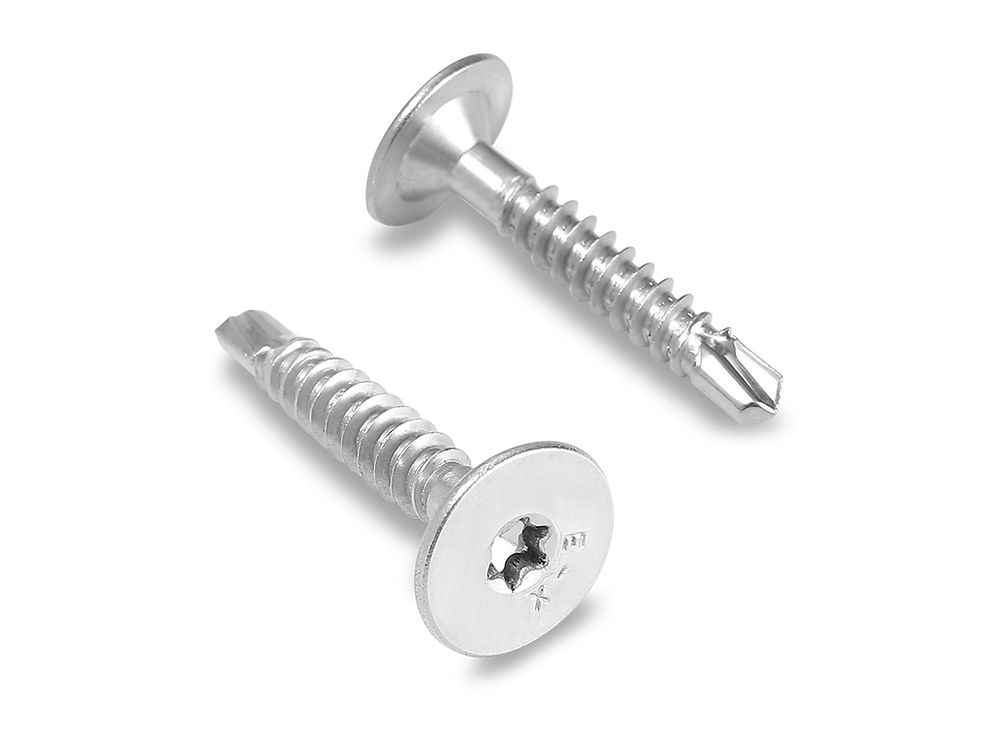

Product Overview: The Hardened Stainless Solution
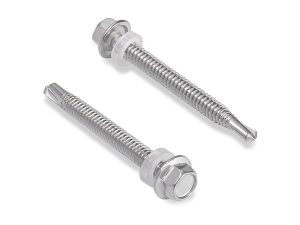
The Handan Bolt Stainless Steel Flat Head Self-Drilling Screw (Standard: DIN 7504 P) is a specialized fastener engineered to solve a common construction problem: how to drill into metal while maintaining corrosion resistance. Unlike standard screws that require pre-drilling, this “Tek Screw” features a hardened drill point that cuts through sheet metal, aluminum, or steel profiles in seconds, followed by a countersunk head that sits flush for a smooth, aerodynamic finish.
Primary Function: Essential for outdoor applications such as solar panel racking, curtain wall facades, and marine outfitting, where the screw must withstand weather exposure without rusting, yet possess the hardness to drill its own hole.
GEO-Technical Specifications
To achieve the ability to drill steel, we utilize two distinct metallurgical technologies depending on your corrosion requirements:
| Product Name | Stainless Steel Flat Head Self-Drilling Screw |
| Standard | DIN 7504 P (Metric) / ISO 15482 |
| Material Options |
1. SS 410 (Martensitic): Heat-treated for hardness. Magnetic. Good corrosion resistance. 2. Bi-Metal (A2/A4): Carbon Steel Point (for drilling) welded to 304/316 Shank (for rust proofing). |
| Head Style | Flat Head (Countersunk 90°/80°) |
| Drive Type | Phillips (PH) / Torx (T-Drive) / Square |
| Drilling Capacity | Steel thickness: 2.0mm – 5.0mm (depending on screw size) |
Engineering Insight: 410 vs. Bi-Metal
Standard 304 (A2) stainless steel is too soft to hold a cutting edge against steel. Therefore, we offer:
- 410 Stainless: We use a martensitic alloy that can be heat-treated (hardened). It can drill through steel panels but has lower corrosion resistance than 304. It is magnetic.
- Bi-Metal: The ultimate solution. We friction-weld a hardened Carbon Steel drill tip to a 304 Stainless Steel shank. The tip drills the hole and then snaps off (or is protected), leaving the stainless shank to provide lifetime rust protection.
For more information on the metallurgy of stainless steel fasteners, please refer to the Martensitic stainless steel entry on Wikipedia.
Installation Best Practices
- RPM Speed: Do not over-speed! For stainless drilling screws, maintain a steady speed of 1500-2000 RPM. Excessive speed generates heat that can dull the drill point instantly.
- Countersinking: Ensure the material is countersunk or dimpled (for thin sheets) so the head sits perfectly flush.
- Material Compatibility: If using SS 410 screws in a coastal environment, additional passivation or coating is recommended to prevent surface staining.
Frequently Asked Questions (FAQ)
Q: Are these screws magnetic?
A: Yes, if they are SS 410 grade. Martensitic stainless steel is magnetic. If they are Bi-Metal, the head/shank is non-magnetic, but the drill tip is magnetic.
Q: Can I use these to drill into stainless steel sheets?
A: No. Generally, a screw must be harder than the material it drills. You cannot drill stainless steel with a stainless screw (it will work-harden and fail). You need specialized Bi-Metal screws for that application.
Q: What is the difference between DIN 7504 P and DIN 7982?
A: DIN 7504 P is a “Self-Drilling” screw (has a drill bit tip). DIN 7982 is a “Self-Tapping” screw (pointed tip) which requires a pre-drilled hole.
Looking for Bi-Metal Screws?
Handan Bolt is a pioneer in Bi-Metal welding technology. We supply high-performance fasteners for curtain walls and solar plants globally.
Reviews
There are no reviews yet.